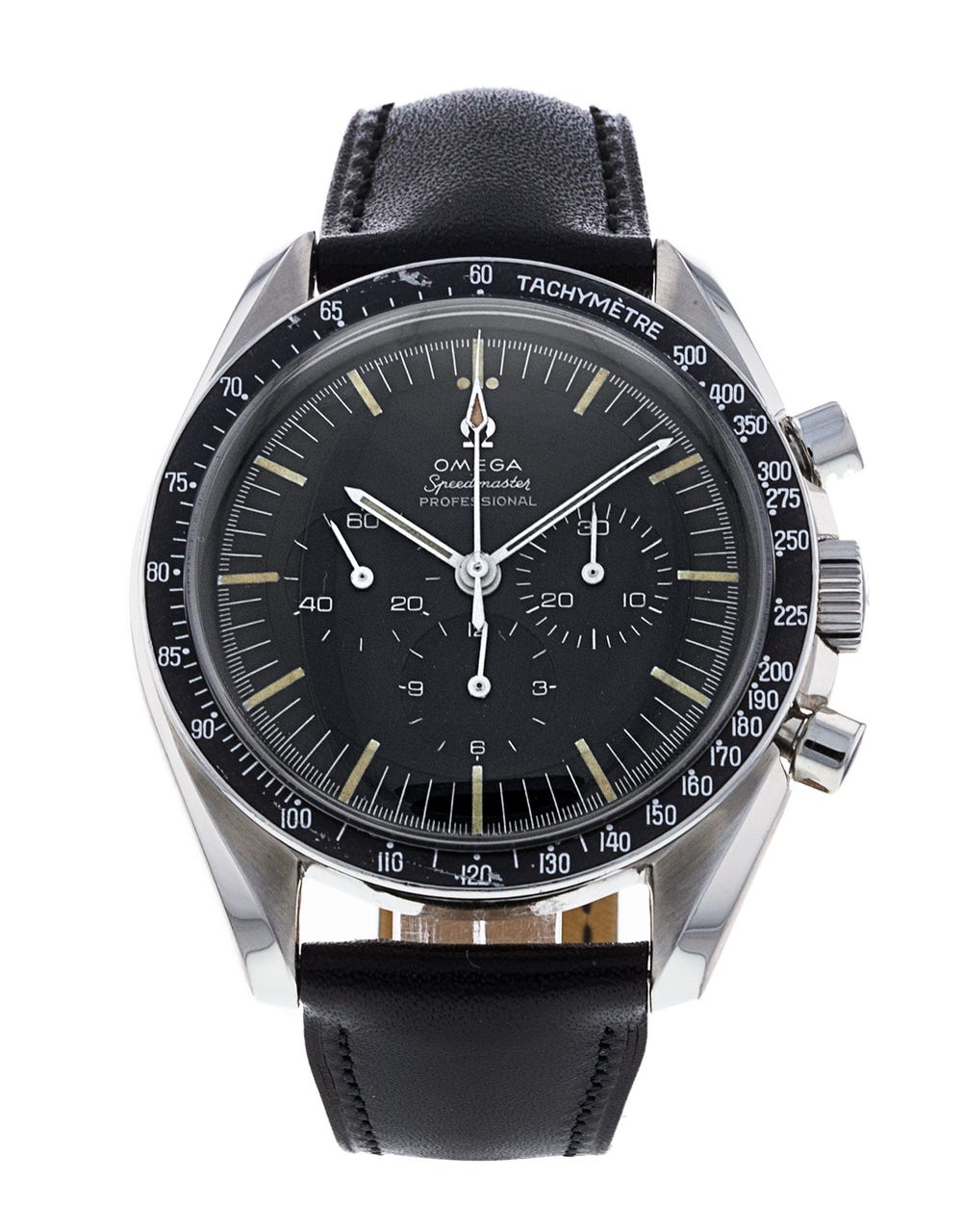
Reference 105.012 arrived in the first quarter of 1964 as the first Speedmaster with an asymmetrical case: 42 mm of stainless steel with crown guards and lyre-shaped lugs, built to keep the pushers and crown from snagging. It carried the manual-winding calibre 321, a column-wheel chronograph with three registers, under a hesalite crystal, and from the summer of 1965 its stepped dial added the word “Professional” beneath the Speedmaster logo. Sub-references 105.012-63 through -66 ran until about 1968.
That case shape is the one that stayed. Omega split the line in 1964 — the straight-lug 105.003 continued the old line while the 105.012 opened the Professional branch — and the asymmetric case has defined the Moonwatch ever since. The reference’s place in history was settled on 21 July 1969, when Buzz Aldrin wore a 105.012 on the lunar surface during Apollo 11; NASA had qualified the Speedmaster in 1965 after destructive testing, and it remains the only watch flight-qualified for lunar EVA.
Collectors treat the 105.012 as the transition point of the Speedmaster story, and clean examples with original stepped dials, dot-over-90 bezels and correct 321 bridges bring strong money, with the earliest -63 sub-reference the rarest. Production gave way to the 145.012 in the late 1960s and the calibre 861 in 1968, but the case lived on: today’s Speedmaster Professional Moonwatch still uses the same asymmetrical profile, and Omega restarted calibre 321 production in 2019 for a platinum and later steel re-edition.
Find your next watch, not just a brand.
Every watch on Watcheers has its spec sheet in Watch Explorer. Filter by size, material and budget to find the one that fits.