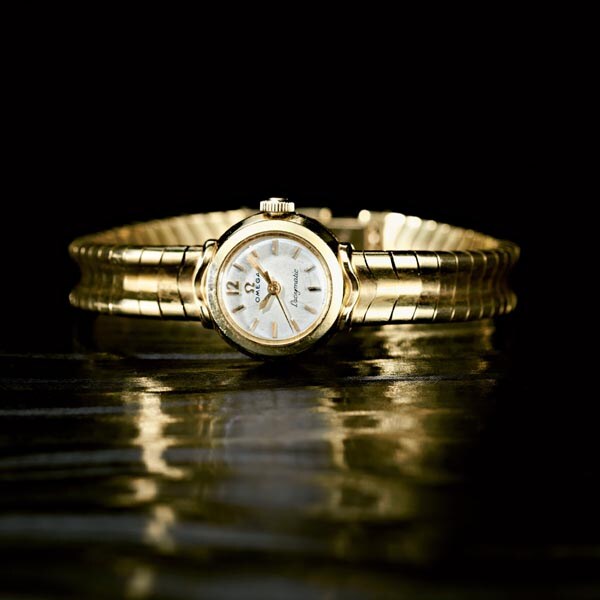
The Omega Ladymatic, launched in 1955, was the brand’s first ladies’ automatic wristwatch and one of the first self-winding watches designed for women. Its heart is the calibre 455, developed in 1953 as the smallest rotor-equipped automatic movement in the world and built specifically for women’s watches. The movement passed the tests of the Official Chronometer Testing Bureau, the forerunner of COSC, and Omega says it became the world’s smallest rotor-equipped automatic calibre to obtain an official rating certificate with special mention. The watch was produced in gold and in steel, with very small, neat cases and dials marked with simple dots or indexes.
The Ladymatic paired compact size with elegant styling, a combination Omega calls revolutionary at the time. Models were worn on leather straps or cords, or on gold bracelets in a style linked to the Constellation Gold Luxe. Omega also commissioned jewellery versions: Gilbert Albert set one as a pendant with a piece of meteorite, and Andrew Grima later created his own designs around it. The Ladymatic remained an important design for almost two decades, until the arrival of quartz made the name redundant. Several original examples are kept in the private Omega museum at the brand’s Swiss headquarters.
Omega describes the Ladymatic as a sensational success from its launch, and today it is remembered as a model that took women’s watches seriously as precision instruments rather than only as jewellery. Its small, neat case and simple dial are what collectors associate with the model, while its modest size reflects the conventions of 1950s ladies’ watches. The original 1950s Ladymatic is no longer produced. Omega revived the name with a new Ladymatic in the De Ville collection, which uses a Co-Axial movement with a silicon Si 14 balance spring and remains in the current catalogue.
Find your next watch, not just a brand.
Every watch on Watcheers has its spec sheet in Watch Explorer. Filter by size, material and budget to find the one that fits.