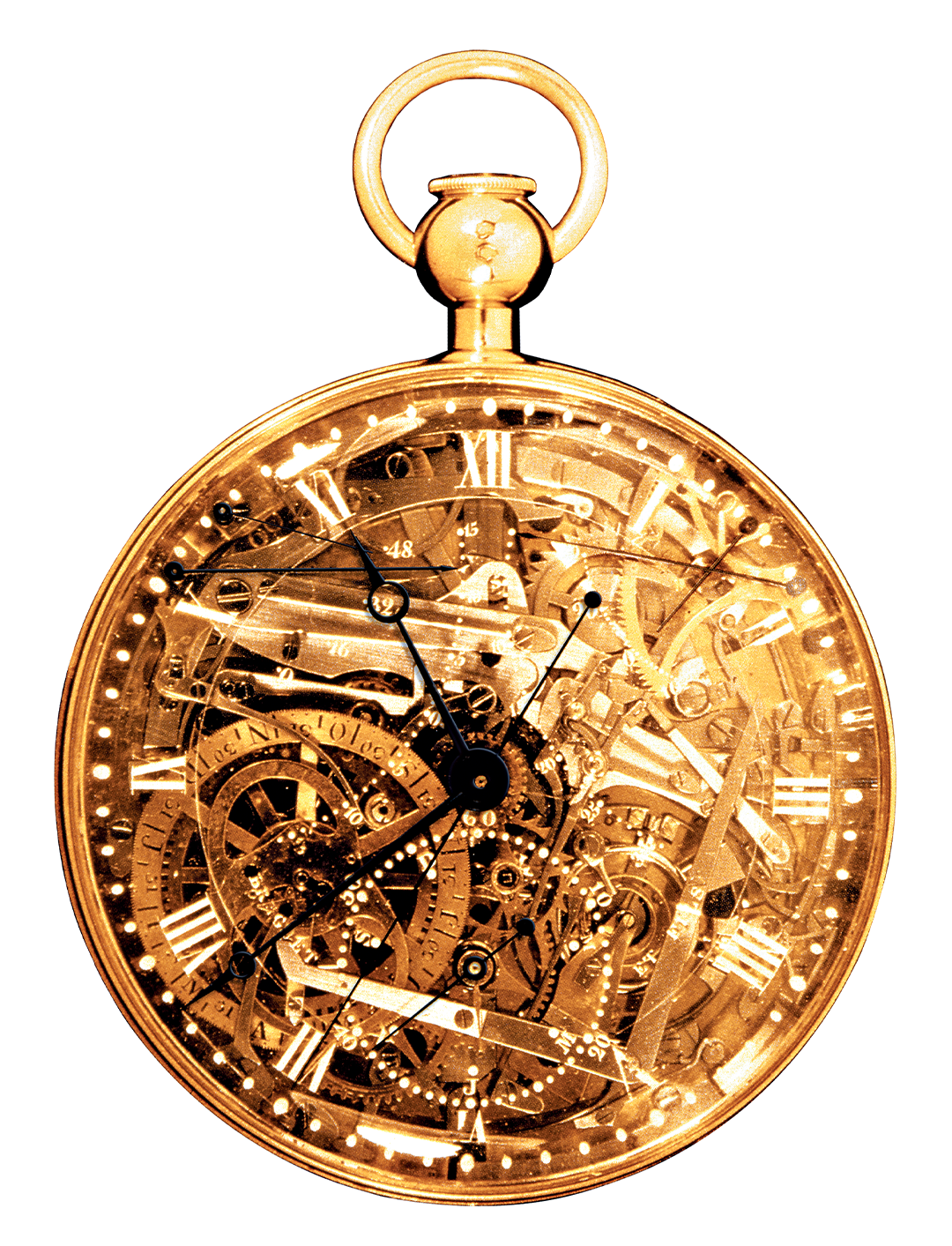
The Breguet No. 160, known as the “Marie Antoinette”, was commissioned around 1783 with a brief to include every complication then possible, with no limit on time or cost and gold used wherever possible. It was completed in 1827. The pocket watch has a gold case and two dials, one in white enamel and one in transparent rock crystal that shows the movement. It winds itself through a platinum oscillating weight (Breguet’s “perpétuelle” system) and offers a minute repeater, a complete perpetual calendar showing day, date and month, equation of time, a power reserve indicator, a metallic thermometer, a large independent seconds hand and small seconds. The movement uses a lever escapement, a gold Breguet overcoil and a double “pare-chute” shock protection, with sapphire at all friction points; Wikipedia counts 823 components. It matters because it was the most complicated watch of its time, built by the workshop of Abraham-Louis Breguet over more than four decades.
According to tradition, the order came from an officer of Queen Marie Antoinette’s guard, sometimes identified as Count Axel von Fersen, though the client’s identity has never been confirmed. Work was interrupted by the Revolution and other events, and it was finished 34 years after the Queen’s death. Breguet’s pupil Michel Weber made most of the mechanism, and the watch was finished in 1827 under Antoine-Louis Breguet, four years after his father’s death in 1823. It was bought in 1887 by the British collector Sir Spencer Brunton, passed to Murray Marks and then to Sir David Lionel Salomons, whose daughter Vera Bryce Salomons placed it in the L.A. Mayer Museum for Islamic Art in Jerusalem. On 16 April 1983 the museum was burgled and its clock and watch collection stolen; the thief was later identified as Naaman Diller, and the watch was recovered in 2007 and returned to the museum. In 2005 Nicolas G. Hayek commissioned an exact replica, No. 1160, which Breguet presented in 2008 in a 63 mm 18k gold case, housed in a box carved from an oak tree at the Petit Trianon.
Collectors and writers regard No. 160 as one of the most legendary timepieces in history, and Quill & Pad calls it exactly that. Its story also attracts debate: George Daniels, the watchmaker and Breguet scholar, dated its completion to 1820 rather than 1827, other sources give 1802, and the identity of the person who ordered it remains unknown. At the time of the 1983 theft it was estimated at 30 million dollars, a figure Wikipedia repeats for 2013, and it has never come to auction since entering the museum. The replica No. 1160, unveiled at Baselworld 2008, was itself a notable feat, since the watchmakers had only incomplete photographs, written descriptions and illustrations of the original to work from. The original No. 160 is a unique piece held by the L.A. Mayer Museum for Islamic Art in Jerusalem; it was never produced in series, and the replica No. 1160 made by Breguet is also a unique piece and not for sale.
Find your next watch, not just a brand.
Every watch on Watcheers has its spec sheet in Watch Explorer. Filter by size, material and budget to find the one that fits.