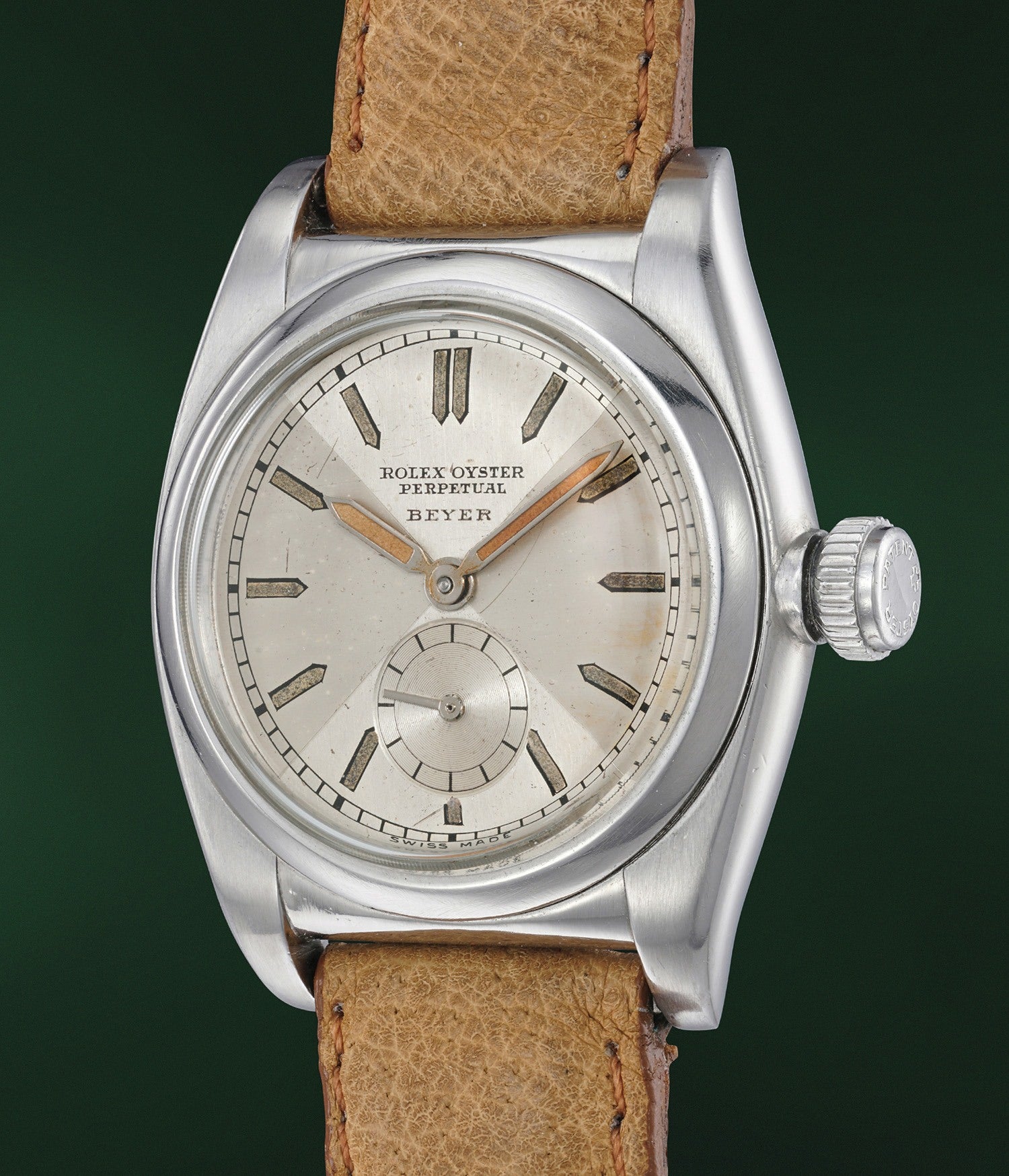
Rolex Oyster Perpetual Bubbleback 1931
Oyster Perpetual · Oyster Perpetual Bubbleback
- Case
- 31.5 mm
- Crystal
- Acrylic
The Oyster Perpetual “Bubbleback” grew out of the self-winding rotor that Rolex patented in 1931, with the first automatic Oysters reaching the market around 1933 and 1934. Among the earliest references are the 1858 and the 2940. A circa-1935 reference 1858 sold by Phillips shows the typical specification: a stainless steel Oyster case of 31.5 mm, a luminous “bow tie” dial, and an automatic 8 3/4 Hunter calibre with a central winding rotor. Standard men’s Bubblebacks generally measure 30 to 32 mm, occasionally up to 34 mm. The model matters because it was the first commercially successful self-winding watch in a waterproof Oyster case, combining the two inventions that still define the brand.
The nickname comes from the convex caseback. Early Perpetual movements carried a thick rotor, so the engineers domed the back of the case to make room for it while keeping the dial side slim. Rolex never used the name officially. Over a production run that Phillips puts at more than 22 years, the family grew to include references such as the 3131, 3372 and 5015, calibres moved from 9 3/4 to 10 1/2 lignes, and steel, two-tone and solid gold cases were offered. Dial variants such as the California, black gilt and honeycomb dials appeared along the way. Flatter calibres introduced in the 1950s, including the calibre 645, made the bulging back unnecessary and the design was phased out.
Phillips describes the Bubbleback as for many years the best-selling model of Rolex, and Bob’s Watches calls it arguably the most important wristwatch in the evolution of the brand. Collectors value it as an accessible entry into pre-war Rolex: common steel examples trade at roughly $5,000 to $8,500, while rare dials in gold start around $30,000, and the Phillips reference 1858 sold for CHF 15,120 against an estimate of CHF 5,000 to 10,000. The main criticism concerns originality, since redialed watches, over-polished cases and swapped movements are common. The Bubbleback is no longer produced; its rotor principle lives on in every current Oyster Perpetual.
Find your next watch, not just a brand.
Every watch on Watcheers has its spec sheet in Watch Explorer. Filter by size, material and budget to find the one that fits.