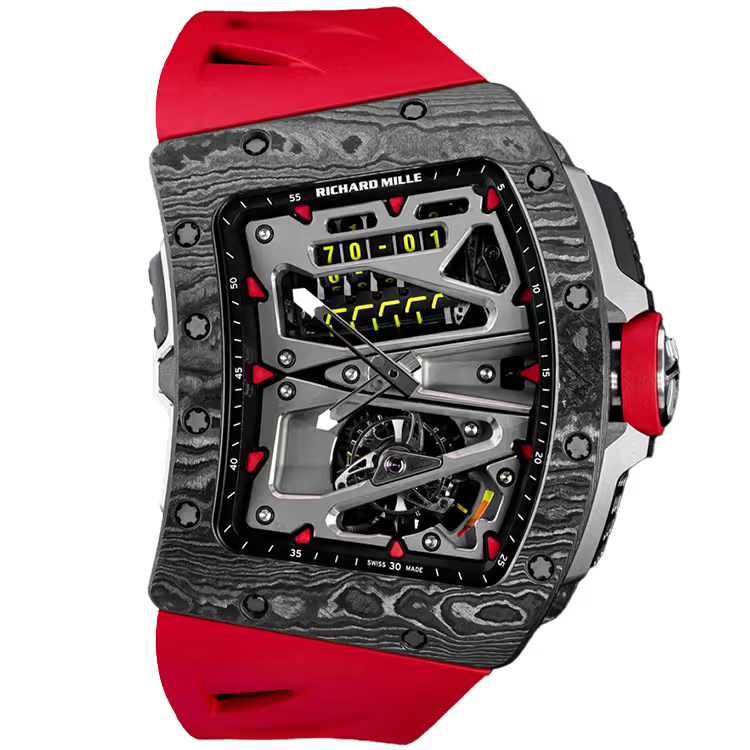
The Richard Mille RM 70-01 Tourbillon Alain Prost is a highly specialized luxury timepiece limited to 30 units, developed in collaboration with the four-time Formula 1 World Champion. Designed specifically for cyclists, the watch features a unique, asymmetrical case machined from Carbon TPT that measures 49.48mm wide and 54.88mm long. This distinctive curved shape is engineered to be worn on the right wrist, ensuring that the crown does not interfere with the hand while the wearer is gripping bicycle handlebars and providing optimized legibility from a riding position. The watch is powered by a manual-winding tourbillon movement, the Calibre RM70-01, which is constructed with a baseplate and bridges made of grade 5 titanium to ensure the durability required for rough cycling trails.
The most notable complication of the RM 70-01 is its unprecedented mechanical odometer, which allows users to manually track their cycling distance up to 99,999 kilometers. This system is operated by two titanium pushers: a selector at 2 o’clock to choose one of the five rollers and a pusher at 10 o’clock to advance the selected digit. The movement also includes a 70-hour power reserve indicator at 5 o’clock, driven by a planetary differential. Industrial design cues from the cycling world are integrated throughout, including bridges reminiscent of a bike frame and a dynamometric crown that evokes a bicycle pedal.
General reviews of the RM 70-01 often emphasize its avant-garde engineering and extreme lightness, noting that it weighs only 98 grams despite its substantial 55mm visual presence. While critics frequently point to its polarizing aesthetic and high market price, horological experts praise the innovation required to integrate a space-consuming odometer into a compact tourbillon movement. The watch is widely regarded as a pinnacle of technical storytelling, where the form is strictly dictated by the functional needs of a specific sporting discipline.