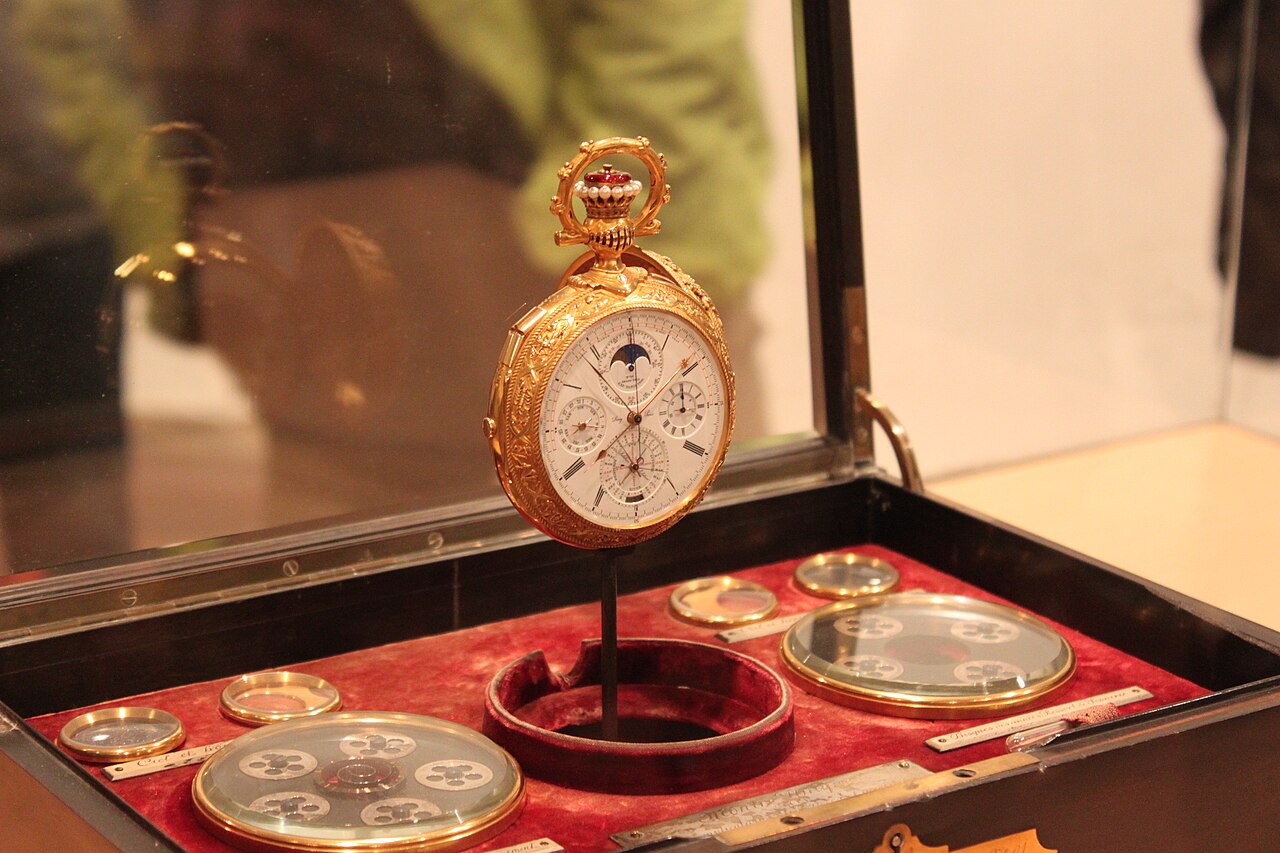
The Leroy 01 is a grand complication pocket watch completed on 15 November 1904 by L. Leroy & Cie of Paris, whose name is signed on the front dial, and assembled in the firm’s Besançon workshops. Its chased 18-carat gold case measures 71 mm in diameter, the watch weighs 228 grams, and the winding crown is set with precious stones. The movement has 975 parts. Sources count its functions differently, from 24 to 27, covering timekeeping with central seconds, a one-fifth-second split-seconds chronograph, equation of time and power reserve; a perpetual calendar with day, date, month, leap-year cycle, century, moon phase and seasons; grande and petite sonnerie and a minute repeater on a three-gong carillon; sunrise and sunset; and scientific instruments including a barometer, thermometer, hygrometer and a compass set into the crown. The rear dial carries a rotating celestial chart, with three interchangeable 27 mm star discs computed for Paris, Lisbon and Rio de Janeiro. For decades it was the most complicated watch in the world.
The watch was commissioned by António Augusto de Carvalho Monteiro, a wealthy Portuguese collector born in Rio de Janeiro in 1848, who asked for everything that science and mechanics could achieve in the volume of a watch. The programme was decided in January 1897, Charles Piguet in the Vallée de Joux began the ébauche that November, and the contract was signed on 5 January 1898. Still unfinished, the watch was shown at the 1900 Paris Universal Exposition, where it won a special Grand Prix. After completion it was exhibited in Besançon from 24 to 27 November 1904 and then in Paris until Christmas Eve. Its caseback is decorated with the Three Fates, designed by Luigi Manini and chased by V. Burdin. In the 1950s the city of Besançon raised 2 million francs to buy it from Monteiro’s heirs, with the formal transfer taking place on 8 September 1956; it is nicknamed “Lucie” after Marie-Lucie Cornillot, the curator who launched the fundraising.
The Leroy 01 is regarded as one of the great monuments of complicated watchmaking: it held the title of the world’s most complicated watch until 1989, when Patek Philippe’s Calibre 89 took it, a reign of about 85 years. WatchesbySJX describes it in admiring terms as a machine for holding several worlds at once, while pointing out that the name on the dial is Leroy although the base movement was made by Charles Piguet in Switzerland. It was a unique commission and was never produced in series. The original is held by the Musée du Temps in Besançon and displayed in the Palais Granvelle; the L. Leroy name was revived as a modern watch brand, owned by the Festina Group since 2004 according to WorldTempus in 2014.
Find your next watch, not just a brand.
Every watch on Watcheers has its spec sheet in Watch Explorer. Filter by size, material and budget to find the one that fits.