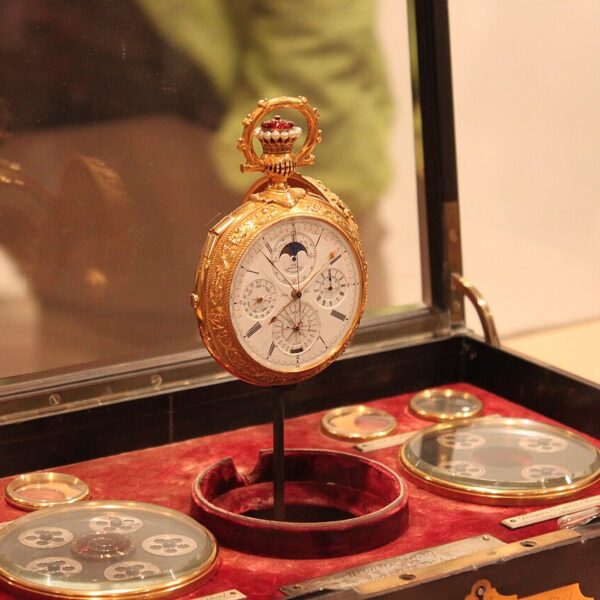
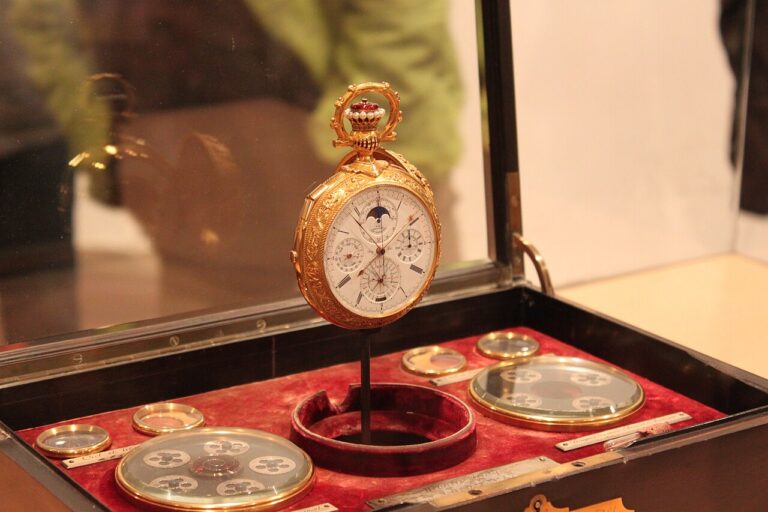
Leroy traces its origins to Paris in 1785, when Charles-Basile Le Roy, son of the watchmaker Basile Le Roy, opened a shop in the newly commercial Palais-Royal; the family stayed at the galerie Montpensier address for more than a century. Charles-Basile became “Watchmaker to the Emperor” in 1805, and the firm was renamed Le Roy & Fils in 1828. It was bought by Casimir Halley Desfontaines in 1845, opened in London as Le Roy & Sons in 1854 and became Queen Victoria’s watchmaker in 1863. In 1889 Louis Leroy, hired by the Desfontaines family a decade earlier, took over and renamed the house L. Leroy & Cie; a workshop was opened in Besançon and the business moved to the Boulevard de la Madeleine in 1899. Its Leroy 01 won first prize at the 1900 Paris World’s Fair and remained the world’s most complicated watch until 1989; it is now preserved at the Musée du Temps in Besançon. After Louis died in 1935 his brother Léon continued the firm, which Léon’s heirs later sold.
In 2004 Miguel Rodriguez bought the company and its archives and brought it into the Festina Group, alongside Perrelet and Soprod. Some collections were discontinued in 2012 and 2013, and after short-lived efforts in 2014 and 2015 the brand went quiet for nearly a decade. It has since been revived under Hugo Lesizza, who joined the project in 2019, marking its 240th anniversary with the Osmior collection, including the Bal du Temps tourbillon minute repeater (2025) and the Elyor flying tourbillon, made in very limited numbers. Its management has said it cannot call itself a French manufacture today, while stressing pride in the brand’s Parisian roots.