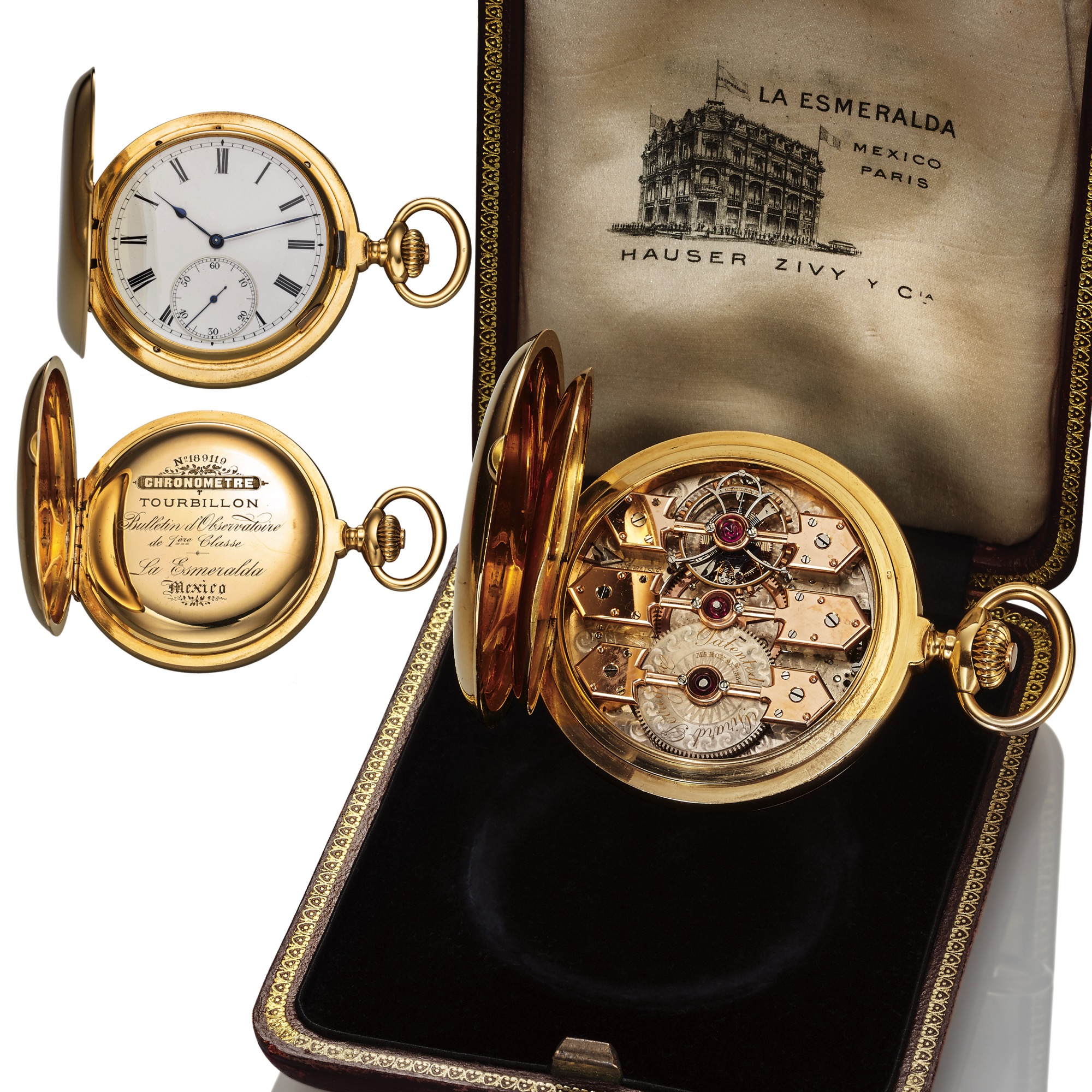
Girard-Perregaux Tourbillon with Three Gold Bridges 1889 La Esmeralda
Bridges · Tourbillon with Three Gold Bridges
The Girard-Perregaux Tourbillon with Three Gold Bridges is a pocket chronometer whose movement parts are held by three arrow-shaped bridges placed parallel to each other. Its defining example, movement No. 168230 known as “La Esmeralda”, received a gold medal at the 1889 Universal Exposition in Paris, the event’s highest distinction, and also earned a bulletin from the Neuchâtel Observatory that year. It combines a tourbillon regulator with a pivoted detent chronometer escapement, and its three bridges are made of gold. Its case was finished by the La Chaux-de-Fonds engraver Fritz Kundert. For reference, a sister movement sold by the same retailer, No. 189119 from around 1895, is documented by Antiquorum as a 20”’ Perregaux calibre with 16 jewels, a gold wheel train, a one-minute tourbillon, a bimetallic compensation balance and a blued Breguet balance spring, in a 57 mm 18k yellow gold hunting case with a white enamel dial. The watch matters because it turned the movement architecture itself into the design, a layout the brand has used ever since.
Constant Girard developed the three-bridge construction from 1860. In 1867 a tourbillon pocket chronometer with three nickel bridges won a First Class Bulletin at the Neuchâtel Observatory and a medal at the Paris Universal Exhibition, and in 1884 Girard applied for a US patent for the “Tourbillon with three gold bridges”, in which the bridges were redrawn as arrows and set side by side. After the 1889 exhibition the prize-winning watch was entrusted to Hauser, Zivy & Cie, owners of the La Esmeralda store in Mexico, which gave it its name. It was reportedly owned by Porfirio Díaz, President of Mexico, and his descendants, before returning to La Chaux-de-Fonds in the late 1960s or around 1970; it is now in the Girard-Perregaux museum. In 1980 the brand made a series of 20 pieces matching the 1889 original, the first of which took 1,500 hours of work, and in 1991, for its bicentenary, it released a miniaturised wristwatch version. The photograph on this page shows No. 189119, a period Tourbillon with Three Gold Bridges pocket chronometer retailed by La Esmeralda around 1895 and sold by Antiquorum, not the 1889 original.
The Tourbillon with Three Gold Bridges is regarded as the emblematic model of Girard-Perregaux, and the auction house Antiquorum calls it “the most iconic and inarguably the most visually appealing tourbillon movement ever designed”. Because these movements were hand-built to order, each period example is treated as unique, and they rarely appear on the market: the c. 1895 La Esmeralda-retailed No. 189119 sold at Antiquorum in New York on 8 October 2016 for 99,750 US dollars, above its 50,000 to 70,000 dollar estimate. The original La Esmeralda is a unique piece held in the brand’s museum and is no longer produced, but the three-bridge design remains in the current collection: Girard-Perregaux today offers the La Esmeralda Tourbillon, a 44 mm white gold wristwatch with the in-house automatic calibre GP09400 and a power reserve of at least 60 hours, alongside other models in its Bridges collection.
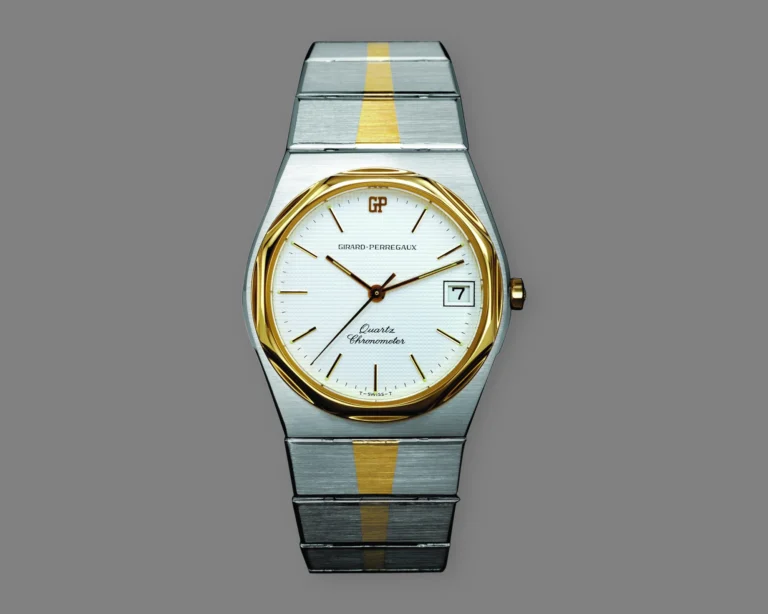
Girard-Perregaux Laureato 1975
Find your next watch, not just a brand.
Every watch on Watcheers has its spec sheet in Watch Explorer. Filter by size, material and budget to find the one that fits.