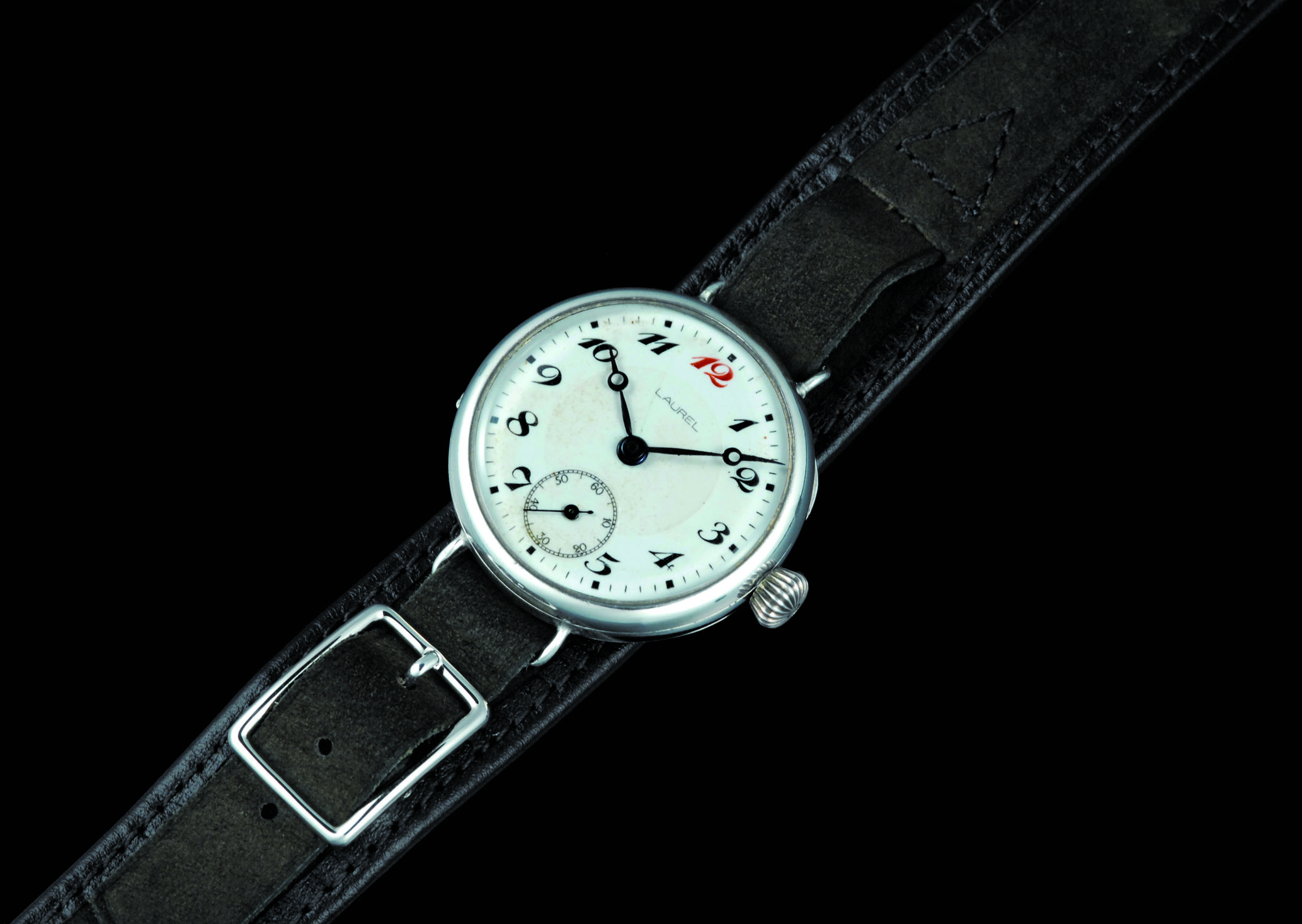
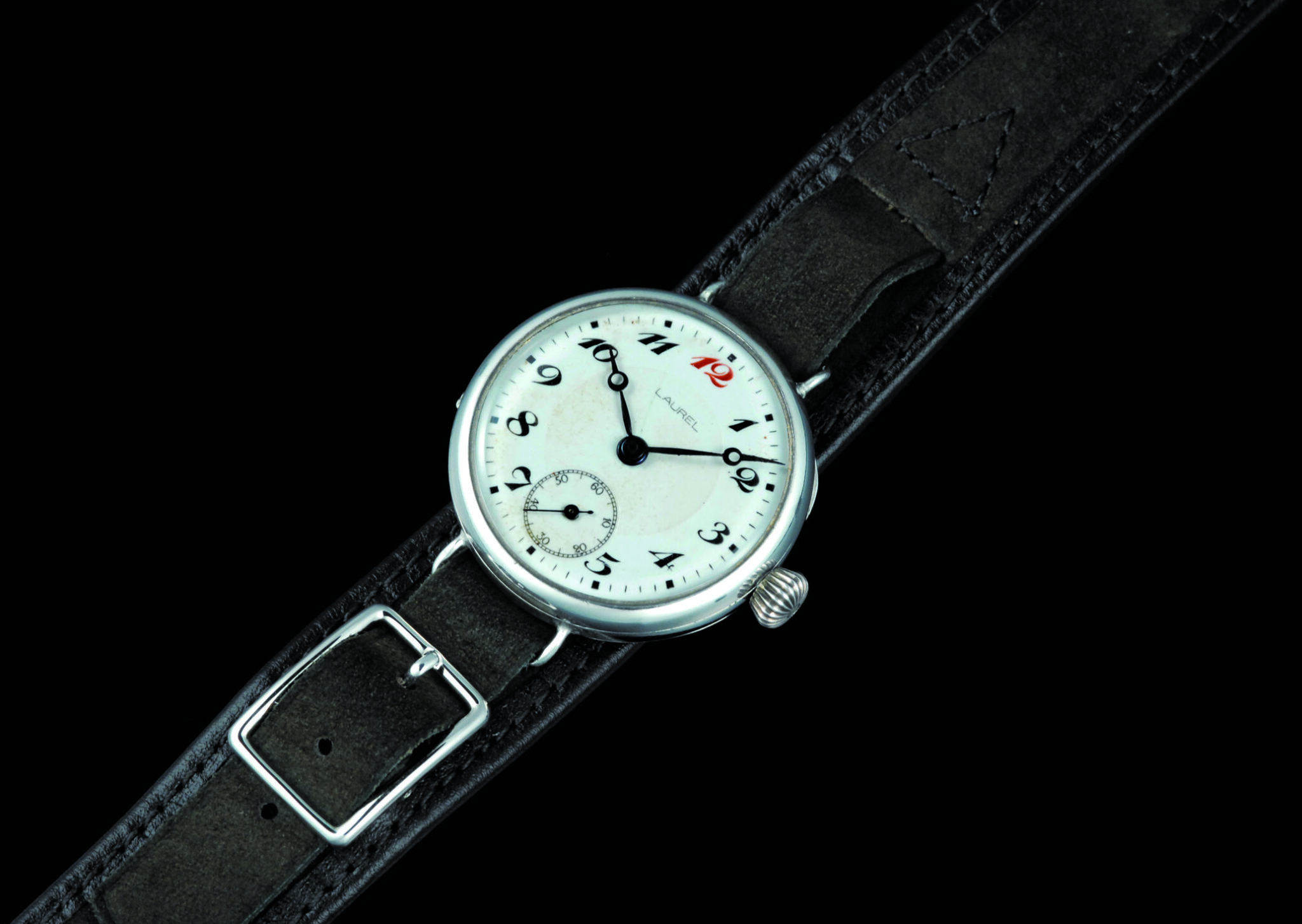
The Laurel was produced from 1913 by Seikosha, the Tokyo factory founded in 1892 by Kintaro Hattori, whose K. Hattori shop in Ginza later became Seiko. Seiko presents it as Japan’s first wristwatch. It used a 12-ligne (26.2 mm) hand-wound movement beating at 18,000 vibrations per hour, most often with 7 jewels and very rarely with 10, a design originally intended for small pocket watches and about one-fifth the size of a standard pocket watch. The round case was made in silver, nickel, 14 and 18 carat gold and shakudo, with articulating wire lugs on early wristwatches and fixed lugs later. The white enamel dial carried Breguet-style Arabic numerals with a red 12, blued hands and a small seconds subdial at 6 o’clock, and the large onion crown sat at 12 o’clock in the original design. It matters historically as the starting point of Japanese wristwatch making.
Kintaro Hattori foresaw that wristwatches would become popular, but making parts this small was hard with the tools of the time, and early output was only about 50 pieces, or a few dozen, a day. Parts were numbered so that matching components could be drilled and assembled together, and craftsman and batch codes were engraved on the movements. The Laurel was offered both as a pocket watch and as a wristwatch, and its dating is debated: one Seiko historian argues that the wristwatch version first appeared in 1915 under the name “Lofty” and was catalogued as the Laurel by 1916, while Seiko keeps 1913 as the official date. Production continued until the mid-1920s, and the Laurel name returned later on 1930s models, a late-1950s series, the 1959 Laurel Alpinist, 1990s mechanical models and the 2000 Historical Collection reference SCVM001.
In 2014 the Japan Society of Mechanical Engineers certified the Laurel as a Mechanical Engineering Heritage, and an example is kept at the Seiko Museum in Tokyo. Among surviving examples, cracks in the enamel dial are common. The Laurel’s design was revived for the brand’s 110th anniversary of watchmaking in the Presage SPB359, a 2,500-piece limited edition released in January 2023 with a 37.5 mm steel case, an enamel dial by Mitsuru Yokosawa and the automatic calibre 6R27; Worn and Wound called it a fairly faithful recreation that looks nearly identical to the original, with the enamel dial as the star, while noting that the added power reserve and date alter the original layout. The original Laurel is no longer produced; Seiko has only revisited it through anniversary limited editions.
Find your next watch, not just a brand.
Every watch on Watcheers has its spec sheet in Watch Explorer. Filter by size, material and budget to find the one that fits.