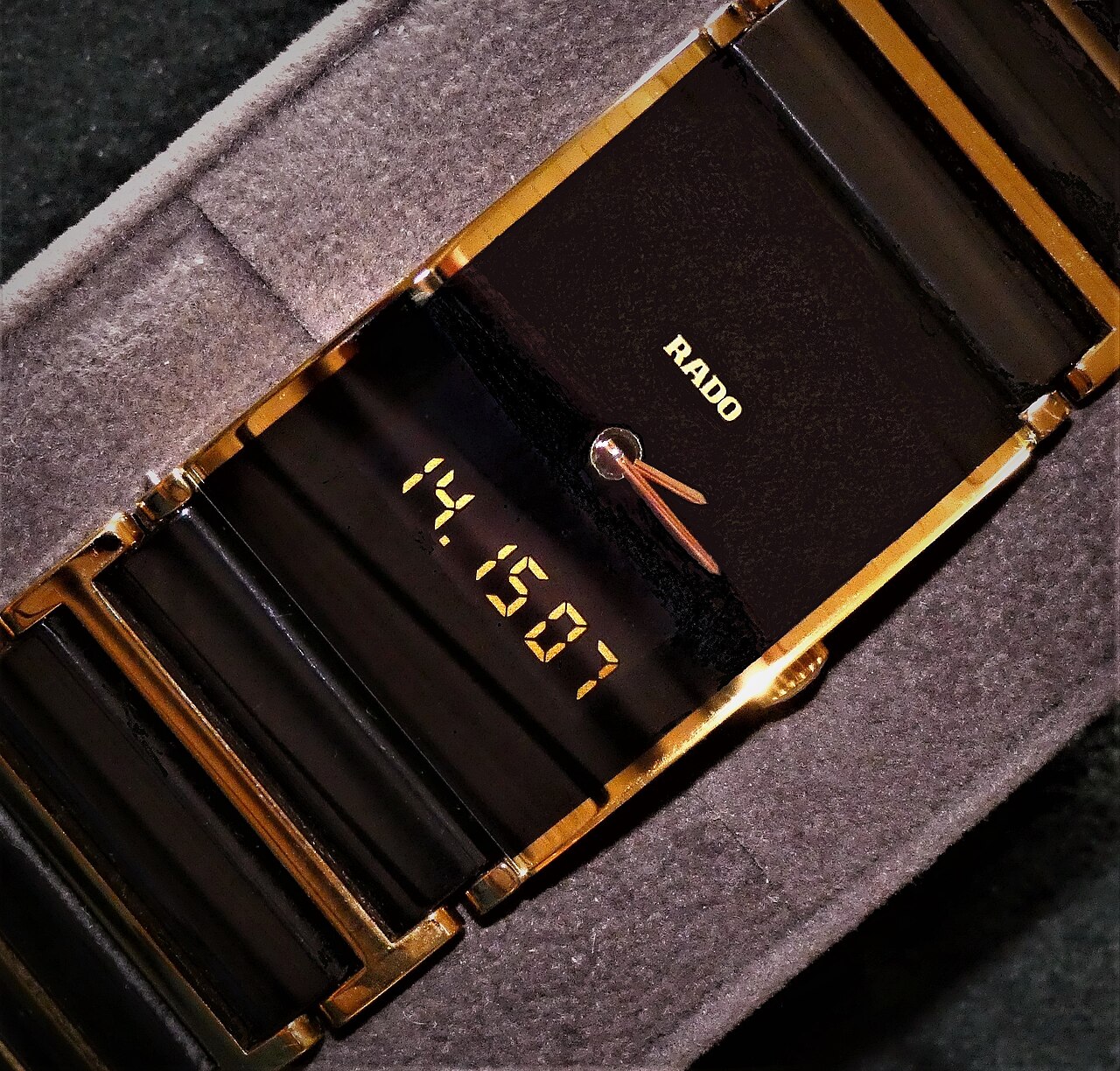
In 1962 Rado released the DiaStar 1 and marketed it, accurately enough for the era, as the world’s first scratchproof watch. Its oval case is built around hardmetal — tungsten carbide fused with a binder metal — a material with ceramic-like hardness that Rado had borrowed from industrial tooling, paired with a sapphire crystal at a time when sapphire on a wristwatch was almost unheard of. Automatic movement, date at three, and a bezel broad enough to cover the strap fixings.
The design is deliberately futuristic: an unbroken oval shield of polished metal surrounding the dial, no lugs in the conventional sense, and a thick profile that sits heavily on the wrist. Rado claimed the case could withstand 22 ATM, and the watch was sold on durability rather than horology — the movement inside was a solid, ordinary Swiss automatic. That was the point: it was the first watch pitched as a tool for people who wreck watches.
Six decades on, the DiaStar is a design landmark and an early example of material-led watchmaking, admired by collectors of 1960s avant-garde cases even though it never carried prestige pricing. Production never really stopped: the model survives today as the DiaStar Original, now using Rado’s Ceramos composite and the same oval silhouette — a rare case of a 1962 icon still on sale essentially unchanged in spirit.

Find your next watch, not just a brand.
Every watch on Watcheers has its spec sheet in Watch Explorer. Filter by size, material and budget to find the one that fits.