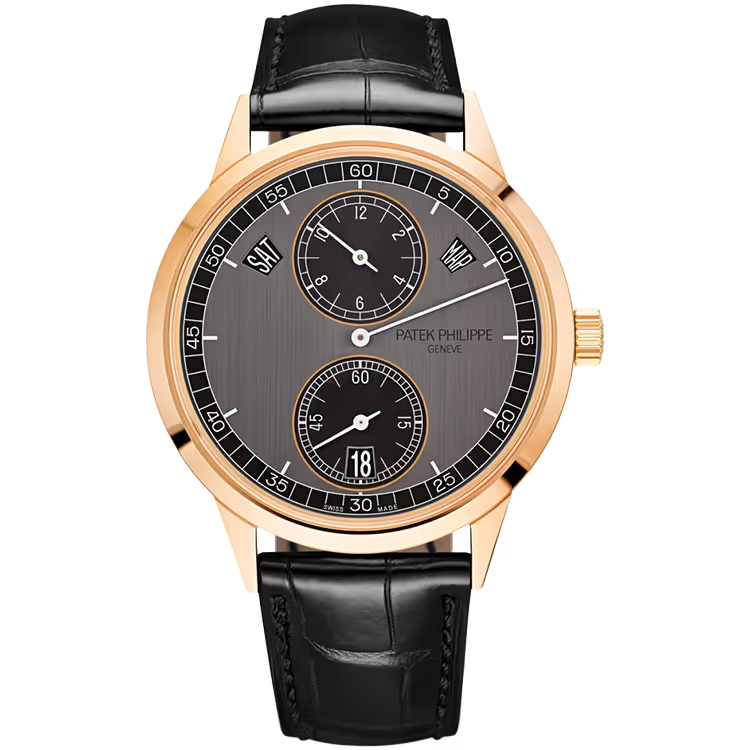
The Patek Philippe Complications Reference 5235/50R-001 is a sophisticated 40.5mm luxury timepiece that blends the brand’s patented annual calendar with a rare regulator-style display. Introduced in 2019 as a rose gold evolution of the original 2011 white gold model, this reference features a 18k rose gold case with a slim 10mm profile and a combination of polished and satin-brushed finishes. The striking two-tone graphite and ebony-black dial is distinguished by its vertical satin brushing and a non-coaxial layout inspired by traditional precision workshop clocks. A central sweep hand tracks the minutes, while hours and seconds are displayed in dedicated sub-dials at 12 and 6 o’clock, respectively.
The watch is powered by the self-winding Caliber 31-260 REG QA, a movement specifically designed for this regulator configuration. It incorporates Patek Philippe’s “Advanced Research” technologies, including a Pulsomax escapement and a Spiromax balance spring made from Silinvar, which enhance accuracy and eliminate the need for lubrication. The annual calendar complication indicates the day, date, and month via apertures, automatically adjusting for months with 30 or 31 days and requiring manual correction only once per year at the end of February. An off-center 22k gold micro-rotor ensures efficient winding while allowing an unobstructed view of the meticulously finished bridges through the sapphire crystal case back.
General reviews of the 5235/50R-001 frequently highlight its unique position as a modern, technical instrument within Patek Philippe’s otherwise classical catalog. Collectors appreciate its balanced proportions, exceptional legibility once acclimated to the regulator layout, and the high-tech movement’s precision. While the aesthetic is considered less conventional than the Calatrava or Nautilus lines, it is often praised for its “intellectual” appeal and versatility as both a dress and everyday accessory. Some minor criticisms note that the regulator layout may feel less intuitive initially and point to the asymmetric placement of the calendar apertures, though these are typically viewed as charming quirks of a highly specialized horological piece.