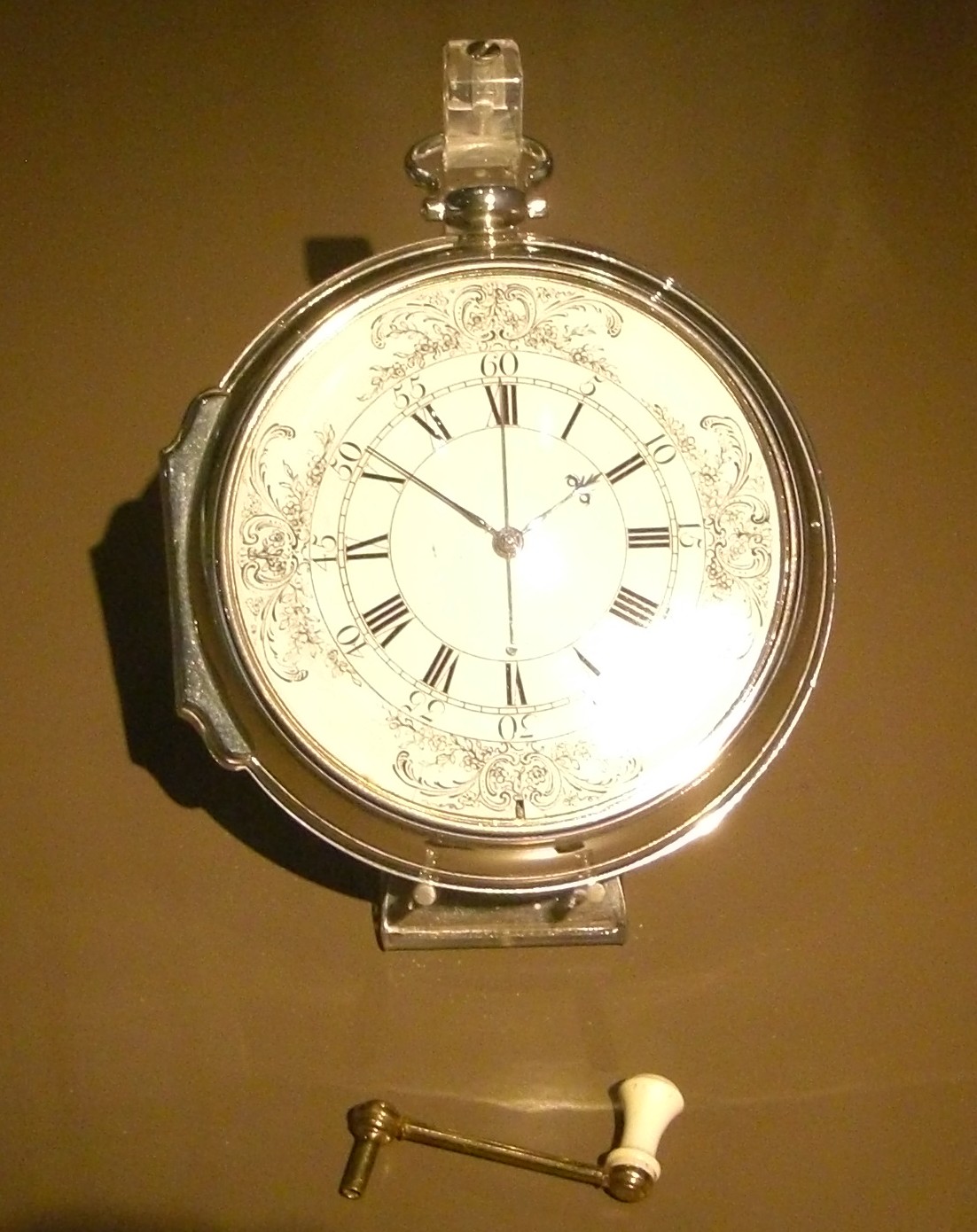
John Harrison H4 Marine Timekeeper
Marine timekeepers H1-H4 · H4
- Case
- 130 mm
- Crystal
- Acrylic
The H4 is the marine timekeeper with which John Harrison solved the problem of finding longitude at sea. It is signed, marked Number 1 and dated AD 1759, and Royal Museums Greenwich records it as completed in 1759. Looking like a very large pocket watch, it sits in silver pair cases about 5.2 inches (13 cm) in diameter. The movement uses a fusee with maintaining power so it keeps running while being wound, a mainspring barrel giving 30 hours of power, and a modified verge escapement with D-shaped diamond pallets. Its large balance, 2.2 inches (56 mm) across, beats five times per second under a flat three-turn steel balance spring, with a 7.5-second remontoire, a bimetallic compensation curb for temperature and a centre sweep seconds hand. A brake stops the balance half an hour before the watch runs down so the remontoire does not also run down.
H4 took six years to build and followed three large sea clocks, H1 to H3. Its key idea came from a watch with a new type of balance that John Harrison had John Jefferys make to his design in the early 1750s, which showed that a small timekeeper could do the job. On its first trial, aboard HMS Deptford from Portsmouth to Kingston, Jamaica, from 18 November 1761 and in the care of his son William, it was found to be only 5 seconds slow on arrival, an error in longitude of about one nautical mile. A second trial to Barbados, with Nevil Maskelyne aboard HMS Tartar, kept time within 39 seconds. The Board of Longitude still hesitated: Parliament paid £10,000 in 1765 on condition that the design was disclosed, Maskelyne’s 10-month test at the Royal Observatory in 1766 to 1767 went poorly, and a further £8,750 came from Parliament only in 1773. Larcum Kendall made a copy, K1, which Captain James Cook used on his second and third voyages. After the First World War, Lieutenant Commander Rupert Gould restored the Harrison timekeepers over many years.
H4 is regarded as a founding object of precision watchmaking. Royal Museums Greenwich describes it as the most successful watch of John Harrison, and Gear Patrol calls it still one of the most important inventions in all of watchmaking history, counting the large watch H4 among the true forefathers of all modern precision watches. The story has a critical side too: some of Gould’s repairs would not meet today’s conservation standards, although he is credited with saving the instruments. H4 was a single instrument and was never in series production. The original is held by Royal Museums Greenwich at the Royal Observatory, where it is kept in a stopped state to protect the movement, which needs oil to run.
Find your next watch, not just a brand.
Every watch on Watcheers has its spec sheet in Watch Explorer. Filter by size, material and budget to find the one that fits.