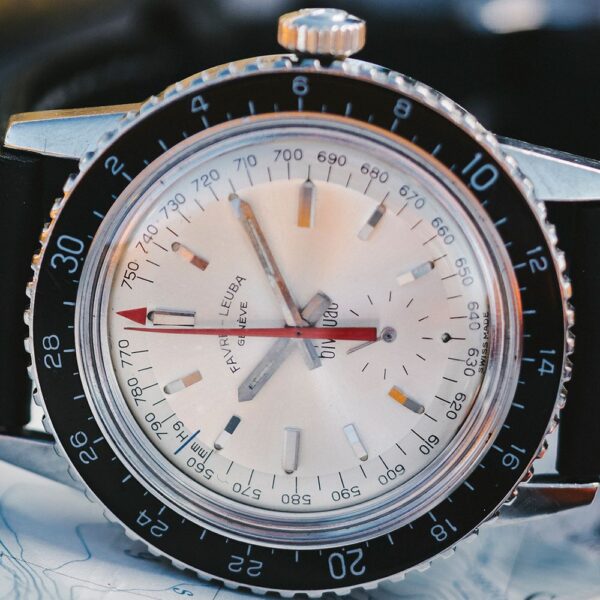
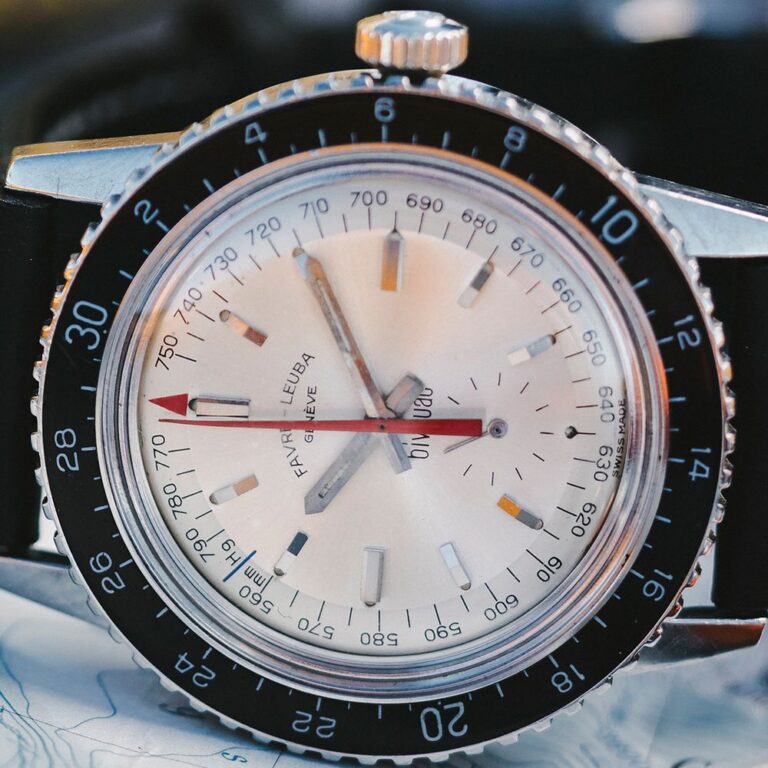
Favre-Leuba dates its origins to 13 March 1737, when an archival document registered Abraham Favre (1702-1790) as a watchmaker with his own workshop in Le Locle, Switzerland, making it the second-oldest watch brand after Blancpain. In 1792 his son, also Abraham, founded A. Favre & Fils with his sons Frederic and Henry-Louis, and in 1815 Henry-Auguste Favre’s collaboration with Auguste Leuba created the Favre-Leuba name. The firm expanded into India in 1865, the first Swiss watch company to do so, and India later became its most important market. It introduced its first in-house manual-winding calibre, the FL101, in 1955, and in 1962 the Bivouac, the first mechanical watch with an altimeter and aneroid barometer, worn by mountaineers such as Walter Bonatti and by Junko Tabei on her 1975 Everest ascent. The Deep Blue diver followed in 1964 and the Bathy, the first mechanical watch to measure dive time and depth, in 1968.
The quartz crisis forced the Favre family to sell the company in the 1980s, after which it passed through several owners including Benedom SA and LVMH. The brand returned with the Mercury Collection in 2007, was acquired by Titan Company of the Tata Group on 16 November 2011, launched the Raider Bivouac 9000 in 2017, and was bought by Silvercity Brands in 2023. Relaunched in 2024 under chairman Patrik Hoffmann with 26 new models at Geneva Watch Days, including a revived Deep Blue, Favre-Leuba is now owned by the Indian watch retailer Ethos and remains an active Swiss brand headquartered in Grenchen.